
The Phenomenological Reduction | Technological Sublime I Painting
INTRO
This article explores the concept of Latent Physicality in painting, highlighting how materials assert their own presence and power, regardless of the artist’s original intentions. By moving beyond traditional perspectives of visual representation, artistic form, and color expression, I investigate the fundamental physical aspects of painting. This shift uncovers a paradox in the creative process: although the artist meticulously controls the medium, materials, and techniques to create the artwork, the act of reproducing the painting’s own material presence—by outlining its physical contours—leads to a gradual loss of control. The materials begin to assert themselves, manifesting beyond what the artist initially intended. Drawing parallels with the Technological Sublime, particularly Jeremy Gilbert-Rolfe’s perspective that technology is both a product of human knowledge and an entity beyond human control, I examine how this loss of control reflects the paradoxical relationship between artists and their mediums..
I would like to begin by discussing the concept of visual representation. Visual representation is not limited to reproducing physical objects; it can also encompass the depiction of abstract concepts, such as logical diagrams or data charts. In the realm of pictorial representation—for example, portraying a real apple—an artist may, based on the lighting at the time, the apple’s contours, texture, and even emotional context, recreate the real apple on a flat surface like paper or canvas, as seen in trompe-l’œil paintings. Calvin F. Nodine and Dennis F. Fisher, in Perception and Pictorial Presentation, mention the concept of optical equivalence, referring to visual expressions that are similar or identical in visual experience to real physical objects. Regardless of how the medium changes—paper, canvas, screens, or virtual spaces—all strive to reproduce this equivalence as closely as possible. However, no matter the methods, forms, or media used in visual reproduction, they cannot replace the material itself. For instance, the physical properties of a red apple that can be picked up and eaten—the way it decays, its rough and uneven tactile experience, its taste—underline the limitations of visual representation.
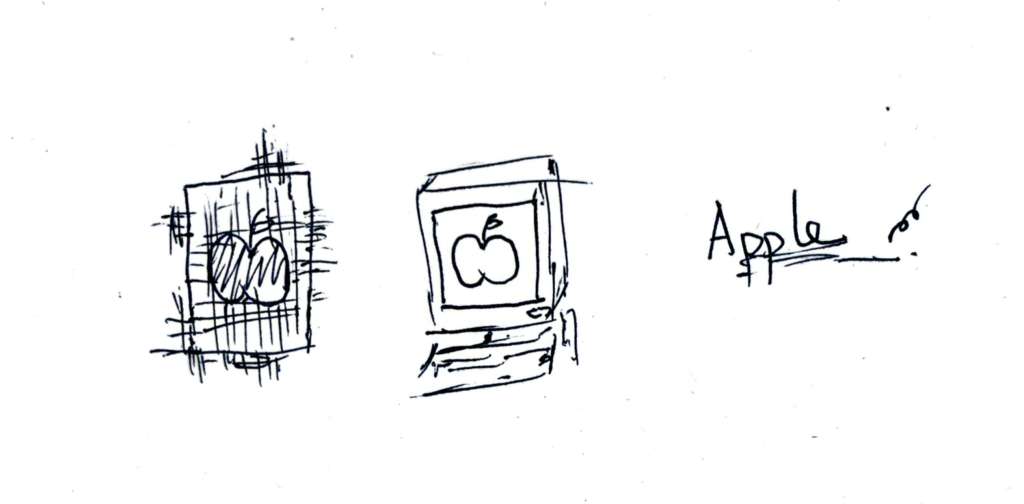
Latent Physicality re-emphasizes the tangible presence—not only of the depicted object but also of the medium that carries the image—and seeks to express and reproduce this material essence in a new way. Unlike traditional visual representation, this concept is not equivalent to texture. Textures are intentional and purposeful; for instance, using paint to create a rough surface to convey wild emotions or to visually represent the material qualities of an object. This depends on the artist’s skills, techniques, choices, and so on; it is controllable and technical. In contrast, Latent Physicality refers to the underlying material presence that supports the visual texture, which is usually unintentional and uncontrollable. It does not focus on the image’s representation or the painting’s form but on the foundational material existence.
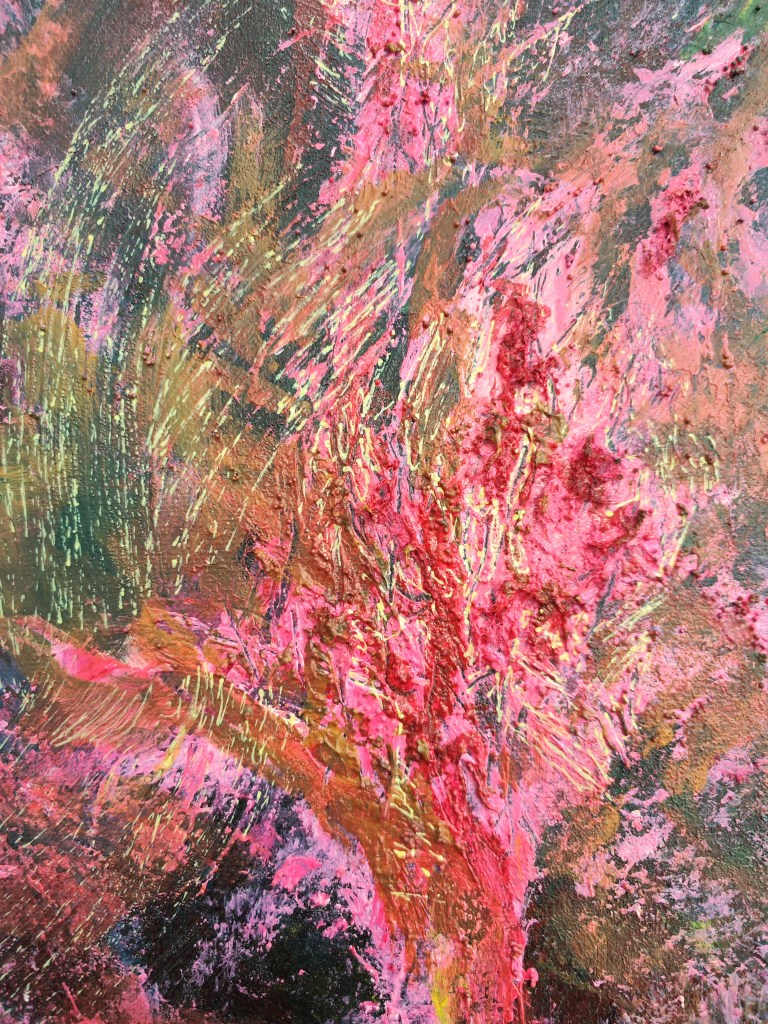

Just as appreciating the transistors and pixels that compose the televised apple reveals the nature of the screen, engaging with Latent Physicality in painting allows us to perceive the artwork’s material foundation, revealing a different “territory” where the material itself communicates its own visual language. Here, the focus shifts to reproducing the medium itself—an aspect that unfolds beyond the artist’s control and was not part of the original creative intention. The materials begin to assert their own presence, leading to outcomes that diverge from what the artist initially envisioned.
To capture Latent Physicality,
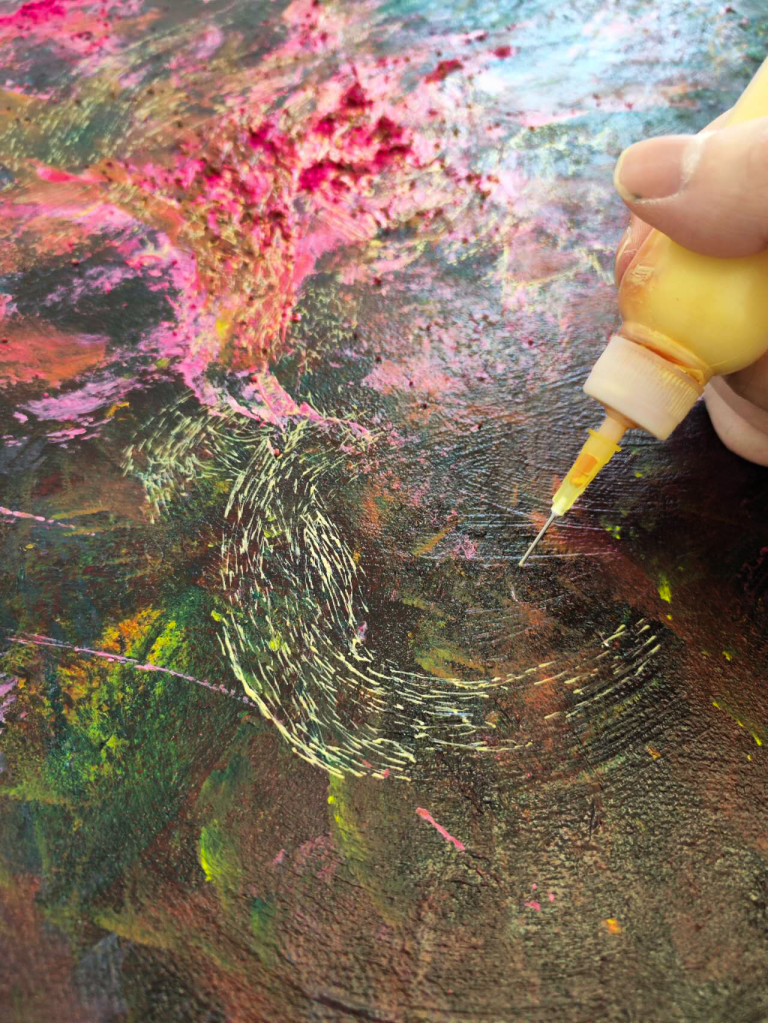
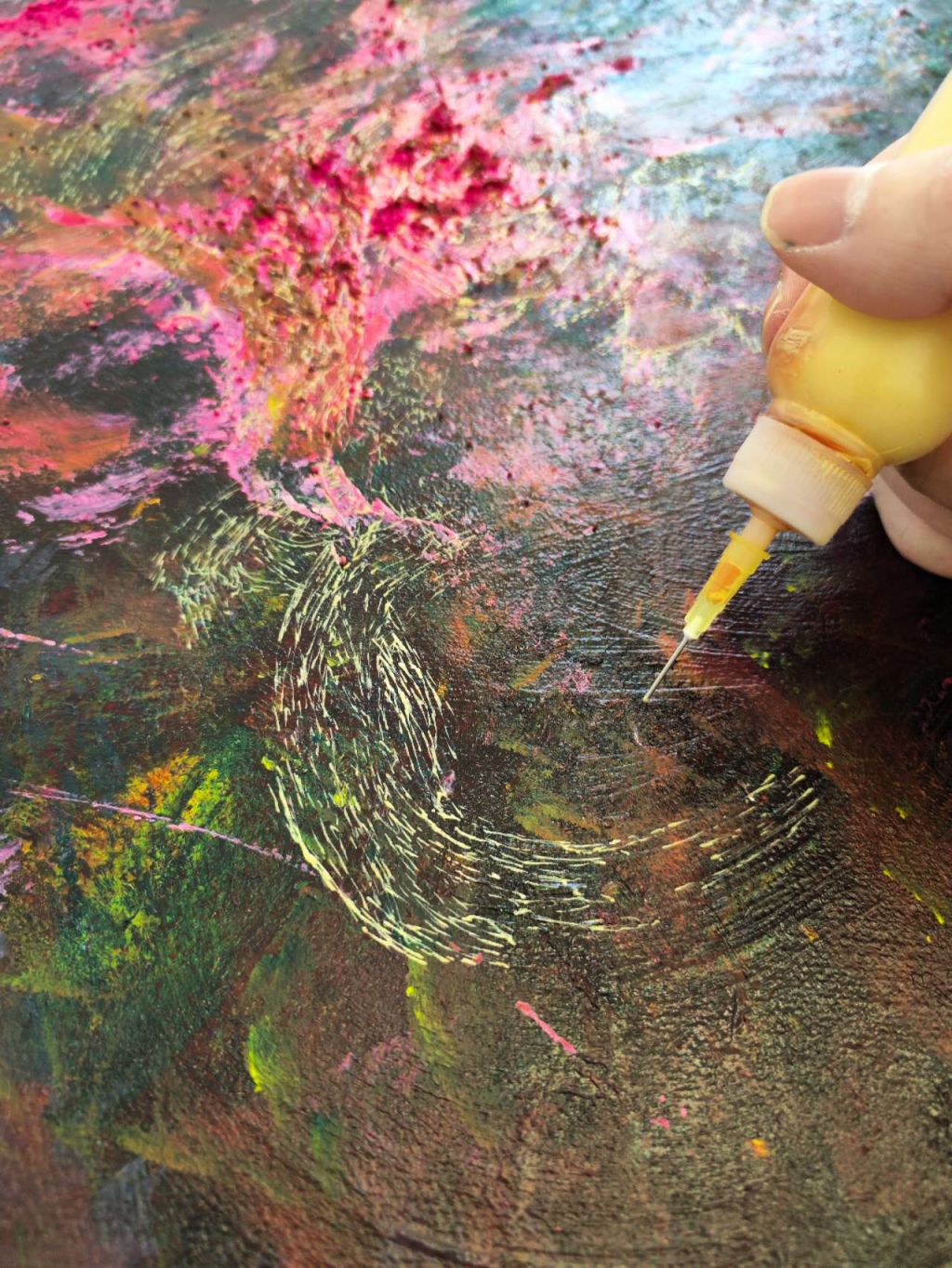
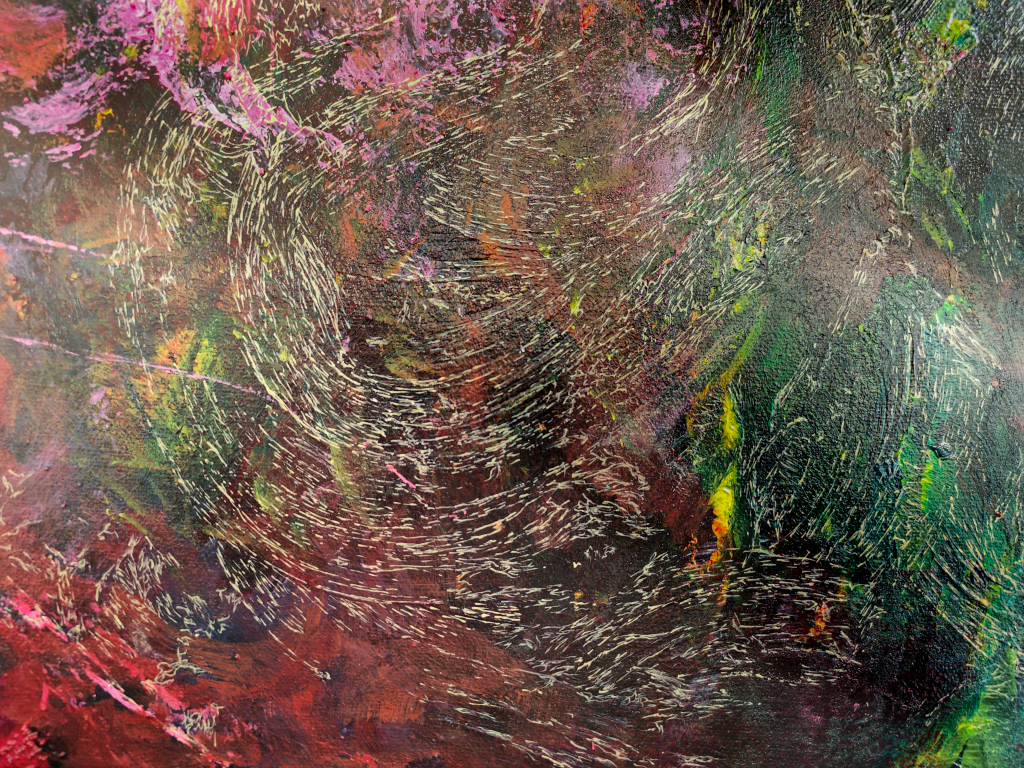
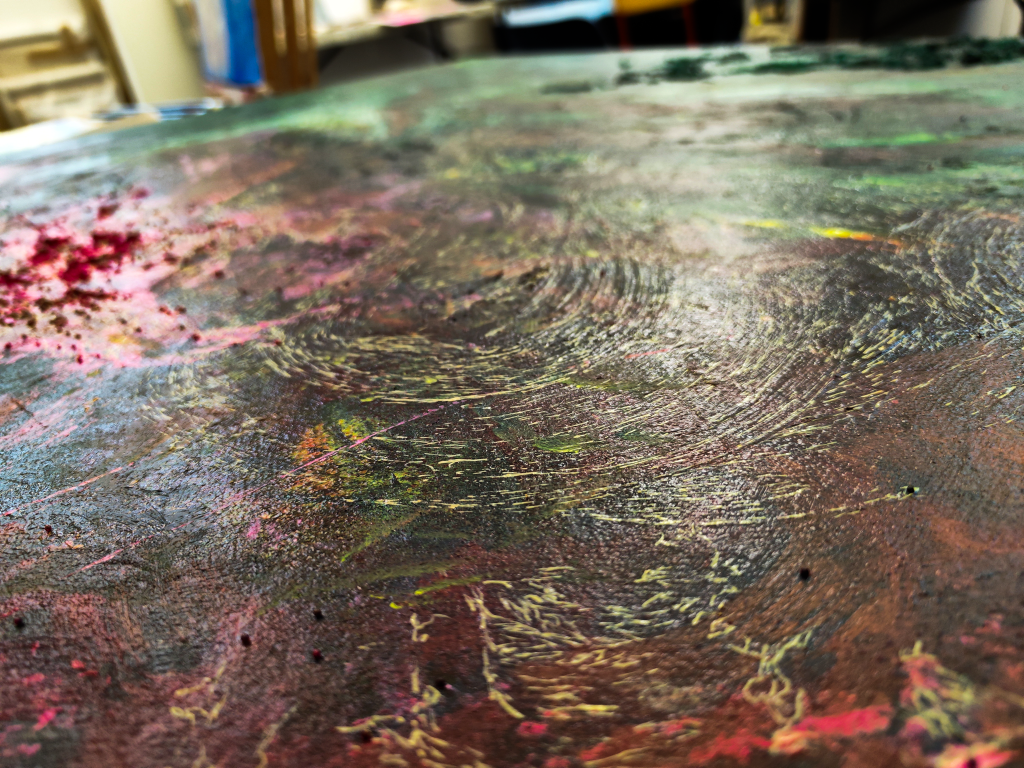
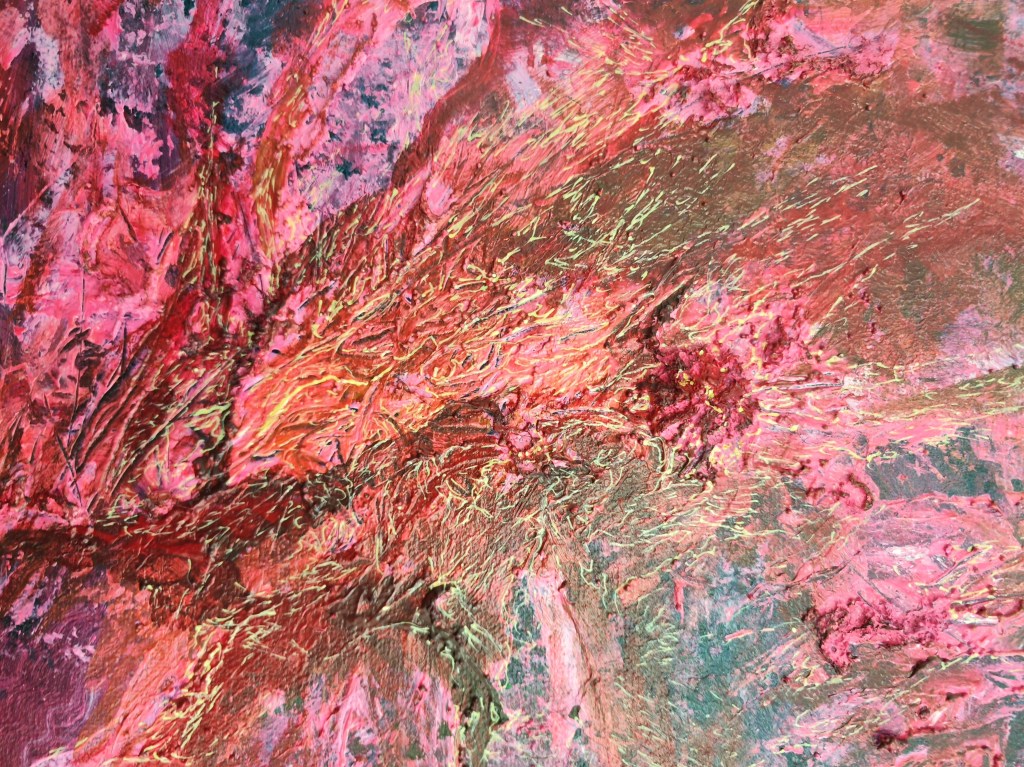
An entirely new approach to observation and creation is required. In traditional painting, especially when producing figurative works, artists typically face the canvas directly, frequently pausing to control the overall composition and precision of form. Everything proceeds according to design and remains under control. However, to enter the realm of Latent Physicality, artists need to observe their work at extremely close distances, even on a microscopic level. By viewing the variations in depth on rough surfaces from an oblique angle, and even touching to sense information that cannot be conveyed visually, the artwork becomes completely defamiliarized when our observation is fully magnified—much like peering into a microscopic world. At this point, we detach from the integrated, macroscopic depiction and focus on the microscopic world of each “pixel.” In this new territory, the artist enters a state beyond control. The brushstrokes originally used for precise image representation, the mixing of media, and all design elements instead create intentional by-products. When we depict these materials by tracing their contours, the brush and movements are no longer under our control; the paint and brushstrokes move in harmony with the properties of the material itself. At this moment, the artist gives control back to the artwork itself.
 DE TANG
2 responses to “Beyond Visual Representation: Exploring Latent Physicality in Painting”
[…] Read more… […]
LikeLike
[…] to technology. Around this time, I wrote a short essay examining the notion of artistic materiality [Read More…], where I discussed Jeremy Gilbert-Rolfe’s view of the technological sublime: that technology is […]
LikeLike